

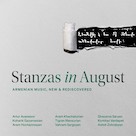
Movses Pogossian: Stanzas in August: Armenian Music, New and Rediscovered
New Focus Recordings
Masterfully midwifed into being by violinist Movses Pogossian and his Armenian Music Project colleagues, Stanzas in August presents the latest far-reaching addition to their multi-volume advocacy for the music of Armenia. The 256-minute collection is smartly presented in four parts, two separately devoted to the music of composers Ashot Zohrabyan and Koharik Gazarossian and the other two featuring material by Aram Khachaturian, Tigran Mansurian, Ghazaros Saryan, Artur Avanesov, Vahram Sargsyan, and Aram Hovhannisyan. Whereas the first part presents chamber ensemble works in different combinations, the fourth emphasizes solo works, with eight of nine delivered by a single player. The logistics involved in producing a release of such monumental proportions are staggering, but the indefatigable energy shown by Pogossian to bring it to the finish line impresses too.
The music of Armenian composers clearly differentiates itself from that of their counterparts in France, Germany, Japan, and elsewhere. If an undercurrent of mournfulness permeates the Armenians' music, it's only natural, given the struggles the country's people have endured, the Armenian Genocide to cite one example. That said, outside influences have seeped into the music to enrich it and broaden its scope. Couple that with the presence of traditional and sacred elements and you've got a music whose branches extend in any number of possible directions. Stanzas in August, which exemplifies that in presenting world premieres, commissions, and homages, was recorded between May 2024 and June '25 at the UCLA Herb Alpert School of Music in Los Angeles where Pogossian is a Distinguished Professor of Violin. A host of instrumentalists joins him, including saxophonist Jan Berry Baker, clarinetist Anoush Pogossian, violinists Varty Manouelian, Eva Aronian, and Andrew McIntosh, violists Che-Yen Chen and Cara Pogossian, cellists Ben Hong and Edvard Pogossian, pianists Nare Karoyan and Artur Avanesov, and the VEM String Quartet (Movses plus violinist Ally Cho, violist Damon Zavala, and cellist Niall Taro Ferguson).
Inaugurating the first volume is Sargsyan's haunting Vox Temporum (2025), with the composer himself delivering the vocal part. Scored for the unusual combination of voice, saxophone, and string quartet, the three-part piece at times sees Baker's alto entwining with Sargsyan's melismatic voice like Jan Garbarek's with The Hilliard Ensemble. Episodes of restless agitation destabilize the opening movement, its adventurousness a harbinger of what follows. Peaceful and supplicating by comparison are the “Manook (Little One)” and "Calmato e poco allungato - Coda” movements. Techniques of various kinds are explored within the piece, from pizzicati and harmonics to whistling and jaw's harp-like throat singing. Also written in 2025, Hovhannisyan's String Quartet bristles with Psycho-like electricity, agitation driving the players' expressions and the composer transmuting their energies into scalpel-sharp gestures of venomous angularity. Saryan's second string quartet (1986) follows, its elegiac intro worlds removed from the fury of the work preceding it. Gentleness gradually morphs into vitality, however, with exuberant assertions by the four players converging into counterpoint, pizzicati, and rhythmic thrust. At disc's end, Avanesov's trio Unruhig (2024) enacts a spiky dialogue between clarinet, cello, and piano, clipped fragments at the start eventually settling into longer if still jaunty cross-currents.
The second volume's a special one for focusing exclusively on the solo piano works of Gazarossian (1907-67), whose music developed against the backdrop of the Armenian Genocide. With her family somehow managing to survive mass arrest, deportation, and death, she was able to continue her music studies (in Paris too) and went on to produce concertos, chamber music, and, of course, solo keyboard music. Karoyan, a recognized champion of the composer, is at the piano for all ten of the pieces, six of them multi-part. Setting the tone, Cantique chimes resplendently, the listener pulled instantly into Gazarossian's singular realm. Huit Variations sur un thème populaire du Père Komitas presents eight succinct variations—luminous, haunting, pretty, and playful—on a prototypically enchanting folk theme by Komitas Vardapet (1869-1935). Two suites appear, the first distancing itself from Armenian style with graceful flourishes of Romanticism and Impressionism, beginning with the first suite's rather Lizst-ian “Prélude” and Ravel-esque “Paresse” carrying over into the second's muscular “Au son du Davoul.” A quartet of Préludes (1947) appears, “Mon enfant, ta mère et morte” naturally solemn, “Chérie, ton nom est Chouchan” radiant, and “La lune de la nuit” hushed. A dignified “Choral” and clandestine “Nocturne (Midi-Nocturne)" distinguish the four-part Album bien tempéré, while “Du monde céleste, les voix arrivent” (from Cantiques de Noël), “O Sainte Vierge agenouillons-nous devant Toi” (Trois cantiques pour la main gauche) and Réjouissons-nous de ta naissance find Gazarossian at her most haunting.
Zohrabyan (1945-2023) is the sole figure featured on the third volume, with three string quartets (all in single movements) interspersed with piano and cello sonatas. These chamber works move away from a strict Armenian style to suggest the influence of other composers (Ligeti and Schnittke come to mind), on his writing. From 1994, the first quartet lunges into action with aggressive gestures before easing into a lyrical passage that's passed baton-like from one member to another. Also performed by VEM String Quartet, String Quartet No. 2 (1998) opens scaldingly but soon enough pivots to an Armenian song by Komitas, “Antuni,” with a rustic violin quote quickly taken up by other members and collecting into a writhing, Ligeti-esque mass. Both quartets aren't without angst and aren't afraid of dissonance, savagery, or luminosity either. The third quartet, arriving twenty-six years after the first and carrying the subtitle Stanzas in August, does in fact develop as a series of self-contained stanzas with conspicuous rests between them. With Avanesov at the keyboard and packaging three movements into one track, Zohrabyan's 1979 piano sonata enters in an array of sprinkles before branching out into probing examinations that blossom from a musical cell. Avanesov's also at the helm of the Cello Sonata, written a year earlier and featuring Edvard Pogossian. Alongside piano flourishes and upper-register plunks, the cello waxes rhapsodically, his lyrical lines thickened with double-stops and bent notes flooding the sound field.
As mentioned, the final volume concentrates on solo performances, with only one of the nine a duo. Works by four composers are presented two, one apiece for Komitas and Tigran Mansurian, two for Khachaturian, and five for Avanesov. Violist Cara Pogossian opens the volume with an impassioned rendering of Khatchaturian's Sonata-Song for viola solo (1976), an inwardly directed excursion that fluctuates between episodes of intensive self-examination and dance-inflected expressions. The disc's other viola setting is likewise performed by Pogossian, this one Mansurian's Ode to the Lotus, which in its character and design is strikingly complementary to Khatchaturian's. The disc's longest solo performance is Eva Aronian's rendition of Khachaturian's Sonata-Monologue for violin solo, with the performance reaching an odyssey-level sixteen minutes. Scored “for singing male cellist,” Dies ist ein Lied für dich allein features Edvard Pogossian on cello but gives the vocal part to Avanesov, the work's composer. Veering into Baroque and lamentation realms, the ten-minute piece assumes the character of a severely stripped-down ritual.
A definite highlight of the final volume is Avanesov's solo piano treatment of Chinar Es…, a traditional Armenian rural folk song that's presented three times. The stirring theme's voiced directly and with little embellishment in the hymnal first version (from Avanesov's book of piano solos, Feux Follets); in his second treatment, the theme's still clearly audible though this time clothed in regal Renaissance garb and subjected to a breezy set of variations; in the last version, Sargsyan's piano arrangement of Komitas' transcription might well be the release's loveliest moment in capturing its serenity so purely. Fittingly, Movses Pogossian gets the last word with a solo violin performance of Avanesov's Cadenza. Needless to say, a recording of such marathon-like duration requires stamina and dedication on the listener's part, especially when a number of pieces push past the ten-minute mark (Gazarossian's seem miniatures by comparison), but effort is rewarded. Enhancing this important release is a deluxe booklet featuring photos, detailed commentaries, a Karoyan article on Gazarossian, and composer tributes to Zohrabyan. Such an elaborate presentation is appropriate for a project of such immense value and one so deserving of attention.June 2026