

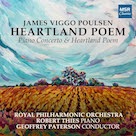
James Viggo Poulsen: Heartland Poem
MSR Classics
James Viggo Poulsen's one of those hard-working American composers who deserves to be better-known. Don't get me wrong: his work's received its fair share of attention and Poulsen himself no shortage of honours; at the same time, when a release such as Heartland Poem presents works of such excellent quality, one can't help but feel like his name should carry recognition value commensurate with the high calibre of the material performed by pianist Robert Thies and the Geoffrey Paterson-conducted Royal Philharmonic Orchestra. Recorded during July 2025 at Abbey Road's Studio 1 in London, the recording pairs Poulsen's Piano Concerto, a splendid three-movement work of broad stylistic and emotional sweep, with the single-movement Heartland Poem, an eleven-minute painterly evocation rich in scenic colour and folk-classical character.
Born in Burlington, Iowa in 1958, Poulsen began composing at fifteen and studied at the universities of South Dakota and Iowa before establishing himself as a composer for the concert stage and film industry. On the one side there are piano, choral, and orchestral works, on the other music created for commercials and business films. Poulsen's also an educator who's taught music at Indianola's Simpson College for thirty-four years and a musician who enjoys playing jazz piano in Iowa and surrounding states. As a composer, his style is described as neo-romantic and reflecting the influence of Copland, Barber, and Glass, though the the presence of the first two is more audible on the release (the titular work especially) than the third.
Better performers for his music Poulsen would be hard pressed to find, Thies an award-winning pianist whose 1995 Gold Medal at the Second International Prokofiev Competition in St. Petersburg (the first American to win a Russian piano competition since Van Cliburn did it in Moscow in 1958) put him solidly on the map and the 1946-founded Royal Philharmonic Orchestra an esteemed ensemble that delivers approximately 200 concerts a year around the globe.
They partner splendidly on the concerto, which opens with its longest and most expansive movement, the nearly thirteen-minute “Rhapsody.” After it's introduced by the soloist with a bravura display, the orchestra enters to amplify the grandiose tone. The vibrant opening section eventually gives way to, yes, rhapsodic piano expressions animated by marching rhythms and orchestral flourishes. A plaintive expression by violin and piano briefly turns the movement into a duo recital before the music swells in force, momentum, and drama and a hint of Copland emerges in the declarations. Relief arrives in the form of peaceful splendour, the piano's expressive ache complemented by gentle strings and woodwinds. So much ground is covered in the work's opening travelogue, it could stand as a mini-concerto of sorts. Written to memorialize two women rom the family that commissioned the concerto, “Elegy” wends fluidly between delicate passages of grief and remembrance. Muted horns and piano intone elegiacally at the start until string and woodwind soloists couple with piano to accentuate the music's solemnity. Thies distinguishes himself with a heartfelt solo turn, as does the orchestra when giving voice to affectingly romantic themes. The tender homage with which the part ends beautifully honours those for whom the music was written. The mood shifts diametrically with the advent of the concluding “Rondo,” its music as energized and urgent as expected. Space is sill allowed, however, for a slow and plaintive episode before the pace picks up for a blazing conclusion.
The programmatically conceived Heartland Poem—crafted to evoke the American heartland, naturally—begins with day dawning and the landscape awakening. Pastoral details of chattering birds and forest creatures pepper a grandiose intro, after which the music takes a rousing, folk dance-like turn that can't help but invite comparison to Copland. Melancholy strings nudge the piece into a contemplative zone, the music growing lyrical, hopeful, and tender with every moment and sparkling like spring morning dew. Dancing figures suggest the area's creatures coming playfully to life until the music barrels forth emphatically and resolves triumphantly. A majestic, full-scale portrait of the land crystallizes as Heartland Poem unfurls in a manner not totally unlike Appalachian Spring.
Both of these Poulsen works could claim a legitimate spot on any symphony orchestra stage, the piano concerto a piece listeners would cotton to with no difficulty whatsoever and Heartland Poem as absorbing and appealing. As mentioned earlier, he and his work deserve to be more widely known; Heartland Poem should help in that regard.September 2026