

Hermitage Piano Trio: Dvorák's Circle
Reference Recordings
Pittsburgh Symphony Orchestra & Manfred Honeck: Dvorák / Simon
Reference Recordings
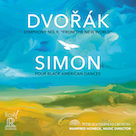
That Antonin Dvorák's ninth symphony, his famous “From the New World,” and Carlos Simon's Four Black American Dances were recorded live in February 2025 at the venue the Pittsburgh Symphony Orchestra (PSO) and conductor Manfred Honeck call home, Heinz Hall, gives this seventeenth chapter in Reference Recordings' Pittsburgh Live! series added visceral punch. Credit's assuredly due to the Soundmirror team (the recipient of over 140 Grammy nominations and awards) for its pristine audiophile documentation of the concert. The performances are likewise commendable, with Honeck and company even managing to make one of the most familiar works in the symphonic repertoire sound, in moments, like music never heard before. The release is also enhanced by liner notes from the conductor that provide a detailed movement-by-movement account of Dvorák's score and include Honeck's rationale for his interpretive choices. That the Simon work receives its first commercial release also adds to its value, as do liner notes by the composer about the work that accompany Honeck's.
He's been the orchestra's Music Director since 2008, and the rapport that's developed between them is evident on this latest set. Each clearly brings out the best in the other, and the Pittsburgh Symphony Orchestra's profile has risen through its association with the conductor. In its Dvorák rendering, the orchestra executes with close attention to detail and attentively follows Honeck's lead. While there are grandiose moments in the four-part work, the ensemble impresses perhaps even more during the work's gentle episodes and in these passages achieves a chamber-like delicacy one doesn't often hear from a large orchestra. Of course it's the works themes, from triumphant to plaintive and in some cases Native American in character, that have made it such an enduring favourite.
Rather than opening boisterously, the first movement enters calmly with lyrical gestures and a fragile texture; one minute in, however, the music erupts with fortissimo, timpani-accented chords as it sets the stage for the first of the work's many themes, this initial one dynamic and powerful and the equally famous second one, arriving four minutes along, stirring in its lyrical beauty. The two are thereafter woven into the symphonic tapestry as the music advances through multiple episodes, the moods, tempi, and dynamics of the music contrasting repeatedly. Note how fluidly Honeck and the PSO effect the transition at the seven-minute mark from the soft voicing of the theme by flute and strings to the crescendo it rapidly rises to. Brimming with restless energy, the movement's rendering captures the excitement a traveler would feel moments before arriving at a new country.
Like the first, the second movement, marked “Largo” by Dvorák, begins calmly and sustains that tranquil state for the moving English horn theme that follows. It's in this movement that the composer begins drawing on Longfellow's “The Song of Hiawatha” (that lamenting theme, for instance, is believed to be the composer's attempt to express the grief felt by Hiawatha for his beloved Minnehaha, who has died); moments in the third and fourth movements also suggest connections to the poem. The tone of the second movement's dignified, even stately, and Honeck and the ensemble deliver a refined reading distinguished by control and finely calibrated dynamics. A robust, scherzo-like section emerges three-quarters of the way in, but the music just as quickly reverts to its lyrical state, the theme rendered silkily by the strings and a violin-cello duet accentuating the music's folk dimension.
Dvorák himself stated that the symphony's scherzo was based on Longfellow's epic and specifically the spirited dancing of the magician Pau-Puk-Keewis at a wedding feast. While the dramatic opening part might call Beethoven or Berlioz to mind, the music thereafter oscillates between engaging folk passages and high-intensity urgency. The closing “Allegro con fuoco” movement explodes in a heroic burst, the music roiling dramatically when not decompressing for gentler folk expressions. Bolstering unity, Dvorák revives themes from the previous movements and reintegrates them into a grandiose concluding affirmation. Even if one were to take issue with some of the decisions Honeck brings to his interpretation, his commentaries show that each choice was made with care and with a sincere attempt to present the work with accuracy and integrity.
A Grammy nominee himself (in 2023 for his composition Requiem for the Enslaved), Simon writes music that weaves strands of classical, jazz, and gospel into ear-catching hybrids, Four Black American Dances an excellent example (even if the music often invites the term Gershwin-esque). The celebratory “Ring Shout,” its title referring to an ecstasy-inducing ritual that sees worshipers moving in a circle, stomping their feet, and clapping their hands, begins the work on a jazzy high with horns blaring and strings sizzling. The graceful swoop of the PSO strings buoys “Waltz,” the tone romantic and the music seductive, after which “Tap!” enlivens the piece with tap shoes clattering percussively alongside spirited declamations from the orchestra. “Holy Dance” ends the piece with agitated flurries simulating a congregation speaking in tongues and wild, jazzy blazes of strings, woodwinds, horns, and percussion. At under fifteen minutes, the work's dwarfed by the symphony but makes for a pleasing partner to it. The pairing of the works is also effective for coupling one well-known and long-established with a shorter one not recorded until now and a refreshing complement to it. Such an inspired pairing is merely one more thing that elevates the release and helps it earn its recommendation.
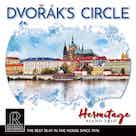
The beloved Czech composer also figures heavily in another recent Reference Recordings release, Dvorák's Circle, the third album by the Hermitage Piano Trio for the label. Whereas violinist Misha Keylin, cellist Sergey Antonov, and pianist Ilya Kazantsev gave their attention to Rachmaninoff and Spanish composers on the first two releases, the trio's latest finds Dvorák's Piano Trio No. 3 in F minor (1883) augmented by Rudolf Friml's Piano Trio “Rural Life in Bohemia” (1918) and two pieces by Josef Suk, his Piano Trio in C Minor (1889-91) and Elegy in D-Flat Major (1902).
The album title's apt: Suk and Friml were not only taught and mentored by Dvorák, they became as close as family members, Suk even eventually becoming his son-in-law. Like Dvorák, whose 1892–1895 stay in America spawned the ninth symphony and other works, Friml visited the United States. Unlike his teacher, however, who after 1895 returned home to compose and teach at the Prague Conservatory, Friml eventually chose to make it his permanent home and in the ensuing years established himself as a Broadway and film composer.
At forty-one minutes, Dvorák's majestic trio towers over the other selections, Suk's fifteen-minute trio the closest in length. But as powerful as the Dvorák work is, the others make strong impressions too, Suk's Elegy and Friml's piece in particular. In duration terms, they're modest—Suk's a mere six minutes—but are potent nonetheless. Recorded during April 2023 at Skywalker Sound in Marin County, California, the release sounds terrific, the separation between the three voices clearly defined and their collective sound harmonious.
If the Hermitage trio's Dvorák performance sounds authoritative, it should: it's been a staple of its repertoire for more than a decade (the US-based group was founded in 2011) and consequently is executed with complete confidence. It's believed that the writing and tone of the work were influenced by the death of the composer's mother only months before it was begun; given that, it's tempting to associate the work's more heartfelt passages with this pivotal life event. Marked “Allegro ma non troppo,” the expansive opening movement exudes majestic sweep as the players deliver its episodic travelogue. Expressive in the extreme, the music scales the heights of romantic passion but also finds moments for playfulness and intense drama. The Hermitage members execute the movement's many transitions so smoothly the many changes in mood never feel jarring. One might expect a slow movement to follow, but Dvorák sequenced it third, opting to present the optimistic “Allegretto grazioso” second as a sparkling folk dance-styled statement. Lyrical moments also appear, however, including a stirringly expressive passage that blossoms three minutes in. The tender adagio, the work's emotional centre, receives a sensitive and patient reading from the musicians, who give articulate voice to the music's forlorn quality and longing. The finale's naturally a fast-paced and high-energy statement; it also casts aside any lingering traces of sorrow for music that's generally hopeful.
Suk's piano trio was composed during his student years at the Prague Conservatory, the eventual performance of the work securing him a spot in Dvorák's composition master class. His teacher suggested further changes, which led to the final version as presented here. An emphatic allegro initiates the work, Suk demonstrating in this early material a gift for thematic development, counterpoint, and the shaping of compositional form. Effective too are the andante movement in its blending of gentle folk dance gestures and romantic expressions and the exuberant “Vivace,” which brims with barely contained energy. His Elegy was written for a celebration honouring, a year after his passing, the Czech writer Julius Zeyer. After vibrato-enhanced phrases are exchanged between violin and cello with piano chords intoning softly alongside, the music in this touching memorial briefly swells in drama before returning to its gentler beginning state. The Hermitage Trio's world premiere recording of Friml's “Rural Life in Bohemia” setting radiates splendour as it progresses from one fondly remembered snapshot to another. Friml sequences nostalgic reminiscences, playful dances, and folk melodies into a sun-dappled nine-minute evocation that's anything but lugubrious and downtrodden.
The two releases have their differences, of course, one being a full orchestra recording and the other a trio, for starters, but in featuring Dvorák works they share a common bond. The players are also different from one release to the next, but the performances on both are exemplary, and Dvorák aficionados should no doubt be delighted to add them to their collections.August 2026