

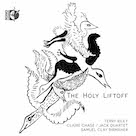
Terry Riley, Claire Chase, & JACK Quartet: The Holy Liftoff
Sono Luminus
One of the more remarkable and laudable undertakings of this century has to be flutist Claire Chase's twenty-four-year Density 2036 project, an initiative she launched in 2013 to expand the flute repertoire and whose end date is scheduled to coincide with the centenary of Edgard Varese's 1936 flute solo, Density 21.5. Calling Chase a visionary hardly suffices at recognizing the magnitude of what she's achieving with her ambitious project. Now, the series' eleventh chapter, The Holy Liftoff (2024), couples her artistry with that of JACK Quartet and American composer Terry Riley.
Even more remarkable than Chase is the composer, who, an inspiration to nonagenarians everywhere, continues to create music of structural poise, melodic allure, conceptual daring, imagination, and beauty. Sixty-two years on from the subversive game-changer In C, Riley has continued to evolve and has produced a staggering body of work highlighted by pieces such as Cadenza on the Night Plain and Salome Dances for Peace. That this mischievous maverick is still capable of creating a work as compelling as The Holy Liftoff is cause for celebration.
One aspect of the new piece suggests he hasn't entirely abandoned the thought processes and methodology that birthed In C. Developing from sketchbook drawings, The Holy Liftoff grew into a work featuring through-composition, graphic notation, artwork, and open-form scoring that (like In C) grants freedom to the work's interpreters and allows for alterations based on ensemble size and character. There's repetition too, but, as Jenny Judge astutely notes in her album essay, Riley's kind never grinds mechanically but instead exudes a lithe, open-air feel.
In New York composer Samuel Clay Birmaher's hour-long iteration (created in close collaboration with Chase and Riley), the open-form work is scored for an eighteen-part flute choir (she multi-tracked) and string quartet; additional sounds are folded in, stones, birdsong, wind, and Riley's intermittent naming of section titles within the work. Much of the music's beauty stems from the melodious chime of Chase's flutes but also writing that testifies to the composer's enduring command of melody.
Riley's playful side is present in the music (see "Angels in the Snooker Parlor” and the jazzy “Horizon Streakers Rag”) and literally seen in the whimsical drawings he created for the project (the colourful one on the CD release's inner sleeve is representative of his “musical cartoons”). Many a photograph of the composer shows him beaming, and that joy also finds its way into the music. The directional movement is, of course, upwards and thus suggesting by association affirmation and even transcendence. The ethereal flute timbres reinforce the intended feeling of lightness; at the same time, an element of tragedy is also part of the mix, specifically the school shooting that took place in Uvalde in April 2022: in the graphic score for “The Tragedy of What We Lost,” the names of the children and teachers killed that day appear, and twenty-one chordal repetitions occur, one for each shooting victim. That this gesture eventually morphs into birdsong is consistent with the overall hopeful spirit of the work.
It begins with “The Holy Liftoff Chorale,” a four-part flute chorus out of which the piece blossoms. After Riley announces the title, Chase's intoxicating flutes undertake their stepwise ascent, at one moment separately and at another in unison. As the flutes take on a church organ-like quality, the strings enter, their sonorous chorale beauty matching hers. The fantastical aura that will generally permeate the work in its entirety is already fully articulated in this first of twenty-two parts. A peaceful march treatment follows that quickly segues into a second chorale theme whose title “Hymn” conveys the folk-like simplicity of the expression. Moments of improvisation surface too, heard, for instance, in the flute solo that glides across the strings during “Chorale (cameo).” When the work advances into the rhythmically insistent “C Major Ishi,” subtly ominous “E-flat minor Ishi,” and plaintive "Ishi Dream,” the sound field expands to include the striking sound of rubbed and struck stones (“ishi” Japanese for “stone”). A hushed, reverential ambiance is established by “The Realm of the Silver Balloons” in anticipation of the haunting, poetic lament “The Tragedy of What We Lost.” Reprising the surging ascensions of the opening chorale is “All Arise,” after which “Pulsing Liftors” gently oscillates like some side-long nod to minimalism.
Something that's no doubt helped sustain and nurture Riley's creativity across the decades is his embracing of collaborative opportunities. As much as The Holy Liftoff is his composition, full stop, it wouldn't possess the form it does minus the creative contributions of Birmaher, Chase, and JACK Quartet. Given his cheery outlook, it hardly surprises that Riley's attitude towards his life's termination, whenever it comes, is not only characterized by equanimity but also positivity. “I'm going to lift off too, in the not-too-distant future,” says this inspirational figure, “I'm looking forward to that!”September 2026