

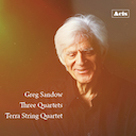
Greg Sandow & Terra String Quartet: Three Quartets
Acis
Success as a music journalist in no way guarantees an equivalent degree of success will be achieved as a composer. Yet in making that move, Greg Sandow in no way stumbles; on the contrary, he makes doing so seem like the smoothest and most natural of transitions. It's not as if he wasn't qualified to write music: his life has oriented itself around it from the beginning, and after being accepted into the Yale School of Music, Sandow earned his Master's degree in composition in 1974. Writing gigs as a music critic for The Village Voice, Wall Street Journal, Vanity Fair, and Entertainment Weekly followed, as did teaching stints at Juilliard (for twenty-six years), the Eastman School of Music, and the Peabody Conservatory.
And then, in 2025 at the age of eighty-two and recommitted to composing, Sandow recruited the award-winning Terra String Quartet (violinists Harriet Langley and Amelia Dietrich, violist Chih-Ta Chen, cellist Audrey Chen) to record three of his string quartets. Fittingly, the album's opening piece, Quartet for Anne (2001), was written as a surprise birthday present for his wife, Anne Midgette, who—wouldn't you know—was also a classical music critic, she for The New York Times and Washington Post. It's followed by the slightly longer The Remembered Song (2018) and finally the album's dominant piece, Mahler Variations (2004), which presents twenty-two variations on a theme from the final movement of his third symphony.
Sandow personalized Quartet for Anne even more by weaving into it bits of his music she'd been exposed to during their life together: one melody at the end derives from a song he wrote for her when they met, and two other parts, one lyrical and the other dance-like, are from a still-in-progress opera treatment of Shakespeare's As You Like It. Compact at five minutes and impressive for its integration of disparate elements, the work covers ample ground in this deeply felt rendering by the Terra String Quartet. If the results exude warmth, love, and affection in their realization, it was intentional.
Drawing for inspiration from his spiritual life and specifically a passage from A Course in Miracles, Sandow wrote The Remembered Song eight years ago. The book passage meditates on the experience we have of musical pieces dimly remembered and whose wisps of melody seem to emerge from the fog of memory to engender longing, contentment, and comfort. Fragments gradually coalesce into a full quartet expression, the music tentatively awakening and gathering energy and rhythmic vitality. The tone isn't just wistful and nostalgic: darker episodes (reminiscent of Bartok in places) appear that acknowledge the shadowy sides of our nature. For the most part, the piece aligns itself to a stark, contemplative realm, the playing delicate, the music fragile.
As compelling as the opening settings are, the album's major one is its third. While Mahler Variations does use a theme by the composer as the foundation, the work more functions as a portrait of Sandow's life in the way it references cultural touchstones from music, film, and literature. Variations inspired by Mozart, Cage, Webern, Proust, Bellini, Berg, Rohmer, Bach, Antonioni, and even Elvis appear (birds and sheep too) as the twenty-six-minute work unfolds. Naturally, the character of the music changes dramatically as each figure is addressed in this ever-engaging piece.
Mahler aficionados will immediately recognize the plaintive theme, which the Terra String Quartet delivers with patience and poise. The variations that follow are mostly short, many lasting less than a minute at a time. Before you know it, we're on to the bright, Beethoven-dedicated fourth and then just as quickly on to the Elvis-styled fifth. Sandow's allusions to rock'n'roll's subtle but present if attended to closely. Nods to Mozart and the French film director Eric Rohmer follow fast on Elvis's heels before brief stopovers with Bach, Schoenberg, and Webern introduce contrasting colours, spidery pizzicato in the latter alluding to his stripped-down style. A graceful visit with Bellini's followed by one with Michelangelo Antonioni and a variation inspired by two scenes from 1961's La notte. An elegant chorale treatment of the Mahler theme precedes the move into Berg (a Lulu-quoting variation) and Proust, his variation an earnest musical setting of the opening sentence from À la recherche du temps perdu. The penultimate variation riffs on Cage's 4'33” (for practical purposes the recording's “silence” lasts twenty seconds only) before concluding with an eloquent restatement of the Mahler theme and a formal “Coda.”
With his lean physique and full head of (snow white) hair, Sandow cuts a youthful figure. But he more than anyone knows that time is short and that if there's more composing and recording to be done it'll need to happen sooner than later. If Three Quartets turns out, however, to be his sole release, it'll hold up as an exceptionally accomplished one, especially when its material is performed so exquisitely by his collaborators. His emergence as a full-time composer has come late, but it's nevertheless something to celebrate.
September 2026