

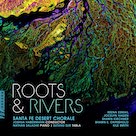
Santa Fe Desert Chorale: Roots & Rivers
Navona Records
With Roots & Rivers, Santa Fe Desert Chorale (SFDC) has released one of the year's most extraordinary vocal ensemble recordings. Two things in particular account for the impression it makes: the vocal splendour generated by its twenty-four SATB singers, and the exceptional calibre of the compositions performed. The personnel listing for the ensemble's second album with conductor Joshua Habermann, its Artistic Director since 2008, includes singers who perform not only with SFDC but also Conspirare, Skylark, VOCES8, and other upper-tier companies. Names such as Chelsea Helm, Sarah Moyer, Sarah Brauer, Elijah McCormack, Savannah Porter, Enrico Lagasca, and Harrison Hintzsche are listed with SFDC but with the others too. It therefore hardly surprises that the quality of vocal artistry would be so high on the release. While the performances are primarily delivered by the full choir, sopranos Porter and Helm and bass-baritones Marques Jerrell Ruff and Edmund Milly step forth as soloists too.
In 2019, the New Mexico-based company, founded in 1982, established the Desert Chorale Commissioning Club to usher new choral works into being, five distinguished examples of which appear on Roots & Rivers. Each is special in its own way: Reena Esmail's The Tipping Point couples the singers with tabla player Sutanu Sur, while Jocelyn Hagen's Caminante deftly reflects Santa Fe's multicultural identity in its imaginative structure and bilingual presentation. Whereas echoes of jazz seep into Kile Smith's four-part Northland, Shawn E. Okpebholo's six-movement suite The American Road comprises audacious re-imaginings of folk songs, hymns, and spirituals before Shawn Kirchner caps the release with Sweet Rivers, its soul-stirring impact bolstered by the piano artistry of Nathan Salazar. He appears with the singers on the Smith and Okpebholo works also and is integral to their impact.
Written for SFDC in 2021 in the midst of the COVID-19 pandemic, The Tipping Point captures Esmail's gift for fusing elements of Indian and Western classical music forms and addresses the pandemic period in provocative manner. The primary takeaway, however, has to do with the conversational to-and-fro between the choir and Sur, whose terrific tabla playing is gripping whenever it appears. An air of mystery permeates the opening section, with both forces accelerating in tandem and the voices swelling grandly; soaring solo turns by Milly and Porter amplify the music's intoxicating atmosphere as Esmail's remarkable tapestry advances towards its luminous resolution.
Smith's Northland offers a quintessential American portrait in the way it explores contrasting emotional states and folds elements of jazz and blues into its design. Set to texts by Claude McKay, an early twentieth-century Jamaican immigrant to New York, the four parts vividly capture the feelings of homesickness, anticipation, and gratitude someone coming to a foreign country and struggling to adapt and assimilate might experience. Salazar complements the choir beautifully throughout, whether the material's addressing homesickness (“The Tropics in New York”), discrimination (“America”), excitement (“On Broadway”), or joy (“To One Coming North”). Northland reflects wistfully on the world left behind and exults in the thrill of big city life but is never more moving than during its majestic closing movement. At album's end, Kirchner's Sweet Rivers is elevated by, first, Salazar's chills-inducing intro and then the singers' moving rendition of the composer's tender, American folk-styled material. Deciding to conclude the album on such an uplifting note was yet another canny move on SFDC's part.
Without wishing to in any way diminish the impression left by the other works, it's the ones by Hagen and Okpebholo that resonate most strongly. She distinguishes herself with Caminante, a bilingual work that captures Santa Fe's multicultural identity in imaginative style. Set to texts by Antonio Machado and Julia Klatt Singer, the piece first splits the choir into two groups, words delivered by one in Spanish and then by the next in English until both come together for the final verse, the polyphonic uniting of their voices glorious and triumphant. We witness here, literally, the positive outcome of different communities joining together.
As stirring as Caminante is, the album's towering achievement is Okpebholo's The American Road for the brilliance of his re-imaginings. With Salazar weaving himself kaleidoscopically into the six parts, the singers deliver startling treatments of well-known African-American spirituals and a mesmerizing treatment of a contemporary folk lullaby by Rhiannon Giddens. Okpebholo shows himself to be a master of reinvention in the way familiar material is made to sound totally new. After bass-baritone Jerrell Ruff elevates the traditional “Prepare Me One Body” with a resonant solo, the suite turns to Giddens' “Little Cuckoo,” which, with soprano Helm in a lead role, recounts the story of an enslaved woman who sings to and nurses not her own child but that of her enslaver's. In place of bitter anger, we're presented with words of almost unbearable poignancy (envisioning a future where the child being breast-fed might one day encounter her own, the woman sings, “If you see my darling girl, treat her nice now”) and lullaby chants of overwhelming beauty. The effect of tinkling piano interweaving with the ensemble's voices makes for music of incredible potency. Arresting too is Okpebholo's recasting of “He's Got the Whole World in His Hands” from celebratory song to tender lullaby; the weaving of vocal fragments and innovative rhythmic change-ups that occur within “Shall We Gather at the River” and the anthemic “Shine! (This Little Light of Mine)” prove as ear-catching.
Listening to Roots & Rivers is riveting, and the heights it reaches make one excited to consider what Santa Fe Desert Chorale will do for an encore. It won't be easy, admittedly, matching what the company has achieved with this tremendous compendium of new American choral music. All five of its pieces exert a powerful cumulative punch and testify grandly to the richness of contemporary American choral music.
October 2026