

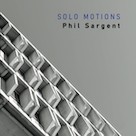
Phil Sargent: Solo Motions
Phil Sargent
Being the recipient of kind words from renowned guitarist Ben Monder would brighten any six-stringer's day. Commenting on Phil Sargent's latest, Solo Motions, Monder expresses appreciation for his colleague's use of counterpoint, texture, and reharmonization and makes admiring note of a delivery that's finessed and expressive. He's right to be complimentary: while Solo Motions is compact at thirty-two minutes, it's certainly long enough for a solid account of Sargent's artistry to be presented; further to that, the solo guitar format allows for it be appreciated all the more easily.
Comprising seven covers and one original, Solo Motions finds Sargent impressing not with flashy solos but more with humble interpretations that put the song first. Arrangement is the guitarist's primary concern, it would appear, when each composition is thoughtfully conceived from the ground up. I picture Sargent, having selected a piece, considering different possible modes of presentation and then resolving details about rhythm, layering, style, tempo, and so on. If a solo is included, it's one that grows out of the material but doesn't stray too far beyond it; the songs' melodies in these cases are so compelling, hewing closely to them proves rewarding enough for performer and listener both. Sargent knows Solo Motions won't sell a million copies; his focus is more on the integrity of personal expression and translating the essence of the material into guitaristic form.
Jazz is of course a reference point—the inclusion of Charlie Parker's “Billie's Bounce” and Thelonious Monk's “Bemsha Swing” guarantees as much—as is the American songbook (“The Way You Look Tonight,” etc.), but Sargent casts a wider net in featuring covers of Trent Reznor's “Hurt” (popularized beyond the Nine Inch Nails version by Johnny Cash's) and Paul Simon's “American Tune.” While the guitarist sticks closely to the originals, they never feel like academic exercises when spontaneity's woven in. To its credit, Sargent's own “Kelita” sounds right at home alongside such classic fare.
One of Monk's old favourites, “I Should Care” initiates the set with reverberant chords and textural shadings. Sargent comes at the main melody circuitously but once broached is voiced directly and with feeling. As often happens on the release, the mood turns introspective when Sargent examines the material probingly, draws out its subtleties, and elaborates on the composition's melodic structure—embroidery taken to the level of art. “Kelita” follows, its jaunty melody strangely familiar despite it being his original. Eschewing distortion, Sargent articulates the theme with clarity and tinges it with tremolo when not building runs upon it. “There Will Never Be Another You" receives a brief run-through, Sargent's chordal treatment referencing its melody from a side angle, before “The Way You Look Tonight” slows the pace for a contemplative reverie. The tempo picks up, naturally, for the bluesy allure of “Billie's Bounce” and “Bemsha Swing,” the guitarist digging into the material as he should. He stays faithful to the lamenting tone of “Hurt” and caps the release with a lyrical reading of “American Tune.” Sargent departs little from Simon's original, but that's a good thing when the song's tone of wistful yearning is so affecting.
Twenty-four years on from his first recording, For Carl, Sargent's still swinging, even when, as is the case here, he's unaccompanied. He performs with a number of ensembles and artists but shows he can be as compelling when heard alone. Paying it forward, Sargent's shared his expertise and experience with private students in New Hampshire and Massachusetts and has delivered master classes at colleges and high schools throughout the New England area too. Aspiring students would do well to sample Solo Motions to not only acquaint themselves with his seasoned approach to the guitar but reflect on the artistic values he brings to such an endeavour.June 2026