

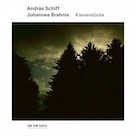
András Schiff: Johannes Brahms: Klavierstücke
ECM New Series
András Schiff's renowned discography includes recordings of Bach, Beethoven, Mozart, Schubert, Schumann, Janácek, and, of course, Brahms. Whereas earlier ECM New Series releases feature the composer's clarinet sonatas, piano concertos, and violin sonatas, Schiff's latest, a double-CD release, concentrates on solo piano material. It begins auspiciously with Albumblatt, a miniature from 1853 by the then twenty-year-old and only discovered about fourteen years ago. Written during a concert tour and later incorporated into Brahms' Horn Trio, the atmospheric reverie makes for interesting points of comparison and departure for the mature works that follow. From it we jump to the Klavierstücke ("piano piece"), op. 76, largely composed in 1878, and then leap ahead to Fantasien, op. 116 and Drei Intermezzi, op. 117 (both 1892) and finally one extra year for two more Klavierstücke sets.
As its English translation intimates, Klavierstücke is something of an umbrella term for a variety of forms, from rhapsodies and impromptus to intermezzi, ballades, and capriccios. A review of the set-list shows Brahms favouring the capriccio and intermezzo, with the ballade, romanze, and rhapsodie making but one appearance apiece on the release. In oscillating between capriccios and intermezzi, the composer brings into sharp relief general contrasts between them, the former animated and rhythmically robust, the latter introspective and restrained. Such facets are resonantly brought to life via the 1859 Blüthner grand piano on which Schiff performs.
Enhancing the project's appeal are track-by-track commentaries he contributed to the booklet, which prove illuminating. In many a case, a single sentence offers a way into his thinking; in a small number of instances, however, Schiff writes at length to share articulate thoughts on the music's formal design and emotional dimension. Sometimes the characterizations turn poetic and impressionistic. About the first “Intermezzo” in op. 76, he writes, “A pleasant stroll in the park accompanied by the gentle ripple of the fountains.” Whereas one piece is described as “sinister, dangerous, manic,” others strike him as “sweet and tender” and “sombre, elegiac, full of sorrow and resignation.” Comparing one's own impressions with Schiff's as the recording plays adds a fascinating element to the listening experience.
The expressive Albumblatt is more pretty than melancholy; even so, the exquisite touch Schiff brings to the rendering bodes well for what follows. The eight-part Klavierstücke, op. 76 begins tempestuously with its first of four capriccios, characterized by the pianist as a “stormy night” that in one passage alludes to the finale of Mozart's Symphony No. 41 (the “Jupiter”). Irreverent, mischievous, and playful is the second capriccio, while the lyrical first of four intermezzi softly sparkles like sun glinting though summer trees. Whereas the graceful second intermezzo sails harmoniously through its contrapuntal skies, the chorale-styled fourth exudes a forlorn solemnity.
In contrast to the eight multi-directional parts in op. 76, the seven Romantic settings of Fantasien form a cohesive whole, beginning and ending as it does with capriccios in d minor. That said, its material doesn't lack for variety, with one part exuding Hungarian flavour and another a hymn-like expressiveness. There's turbulence and high drama but also serenity and calm. A trio of intermezzi forms a mini-suite within the cycle, each one noticeably different from the others, the rhapsodic first a hushed nocturne, the second a probing, gently insistent rumination, and the third a tender chorale.
The release's second half begins with the introspective beauty of Drei Intermezzi, op. 117, its folk lullaby-like first especially beguiling and voiced by Schiff with poise and well-calibrated pacing. The work totals fourteen minutes, which grants each part ample time to develop mood and character, the requiem-like second elegiac and the sorrowful third haunting. Rounding out the release are the six-part Klavierstücke, op. 118 and four-part Klavierstücke, op. 119, the shift in mood from the funereal third part of Drei Intermezzi to the energized opening of op. 118 clearly audible. A pivot into poetic lyricism occurs with the advent of the second intermezzo, however, until the ballade announces a call to action with a rousing and vigorous statement. Charlie Chaplin loved the “Romanze F major,” Schiff tells us, so much that he adopted it for The Gold Rush, and its romantic splendour makes it easy to understand why. How far removed the bleak and desolate closing intermezzo is by comparison. As the pianist notes, Klavierstücke, op. 119 is distinguished by its following of two intimate settings with two extroverted ones. The opening adagio-styled intermezzo is a profound, clear-eyed inner examination, the second one a sunnier waltz and the spirited third jovial. Ending Schiff's long journey is an E-flat major rhapsody whose tone of buoyant uplift isn't unwelcome as a set-ender.
Mention also should be made of the booklet essay “Soliloquy in Tones” by musicologist Peter Gülke that offers insights into the music beyond Schiff's. Gülke describes, for instance, Brahms' op. 76 as an homage to Robert Schumann and then identifies details in the works to support the contention. While one can certainly take Schiff's magnificent performances on their own terms, listening to them after reading Gülke's text also adds to one's appreciation of them.
November 2026