

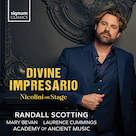
Randall Scotting: Divine Impresario: Nicolini on Stage
Signum Classics
Many things recommend countertenor Randall Scotting's homage to legendary castrato Nicolò Grimaldi (1673-1732), who made opera lovers swoon under the stage name Nicolini and made his stage debut in Naples at just twelve years old. For starters, there's Scotting's tremendous performances, as well as those by his accompanists, the Academy of Ancient Music as led by conductor and harpsichordist Laurence Cummings, and soprano Mary Bevan, who duets with the countertenor on three of the fifteen selections. Divine Impresario is also noteworthy for featuring premiere recordings of nine pieces not heard since Nicolini's lifetime. It's an act of scholarship too, as Scotting includes not only the music Handel wrote for Nicolini but pieces other composers created for the castrato, among them Francesco Gasparini, Nicola Porpora, Riccardo Broschi, and Francesco Mancini. Recorded in November 2024 at St Jude On-the-Hill in Hampstead, the nearly eighty-minute release affords a comprehensive account of both Nicolini's musical world and Scotting's vocal artistry.
The countertenor's own rise has been swift and dramatic. He gained attention in 2019 when he stepped in at the eleventh hour for a production of Britten's Death in Venice at London's Royal Ballet & Opera and then sustained that momentum by joining the roster of the Metropolitan Opera and appearing with other companies around the world. More than just a singer-for-hire, Scotting focused on the castrato Senesino (Francesco Bernardi) and early eighteenth-century Italian opera in his doctoral dissertation and called on that scholarship when collecting manuscripts for the Nicolini project from archives in multiple countries. After carefully making selections from what he'd gathered, Scotting created modern performing editions for the music featured on the release.
Divine Impresario isn't the first time, incidentally, he's collaborated with Cummings and London's Academy of Ancient Music. On his debut album, The Crown, Scotting appeared with the Cummings-led Orchestra of the Age of Enlightenment, while his recent Infinite Refrain presents him with the Academy of Ancient Music. The versatile Bevan is recognized as one of Britain's most celebrated sopranos, has sung numerous roles with many companies, and, like Scotting, has issued a number of releases on Signum Records. Few can hold a candle, however, to the Academy of Ancient Music, which, established by Christopher Hogwood over a half-century ago, has released more than 300 albums.
Broschi's “Mostro crudel che fai?” (Idaspe, 1730) introduces the recording spectacularly, Scotting's towering vocal artistry immediately apparent and the strings-powered AAM sizzling alongside him. As captivating as the music is during its uptempo passages, it's no less riveting during the slow central episode. The countertenor's at his acrobatic best for Gasparini's “Porto piagato in petto” (Ambleto, 1712), Porpora's “Come nave in mezzo all'onda" (Siface, 1726), Handel's “Venti turbini” (Rinaldo, 1711), and Giovanni Antonio Giaj's “Pensa se ancor” (Mitridate, 1729). Regardless of composer, melody is abundant in these settings, which serves both singer and ensemble well.
A one-minute “Sinfonia” from Rinaldo acts as an enticing instrumental lead-in to the poignant aria “Cara sposa,” which, ten minutes long, unfolds in long graceful lines that convey sorrow, Scotting in peak expressive form. In being delivered at an ultra-slow tempo, the piece allows him to stretch his vocal phrases to exquisite lengths, though a few uptempo moments arise too. From the second (and final) opera Handel composed for Nicolini comes “Oh notte!… Notte amica” (Amadigi, 1715), which sees the title character singing alone on stage shrouded in darkness and Scotting again enrapturing with long sorrow-exuding lines as Amadigi entreats the night to grant the sufferer comfort.
The mesmerizing first duet with Bevan, the romantically aching “Spiegami il tuo desio” from Nicola Porpora's Siface (1726), reveals how beautifully their voices complement one another. As star-crossed lovers bidding each other goodbye, their lyrical coupling in Gasparini's “Per te bell'idol mio” (Antioco, 1711) proves no less intoxicating. Enhancing the release is a booklet that includes historical background on Nicolini, lyrics, and detailed track-by-track commentaries that provide helpful story contexts for each song. Illuminating they most definitely are, but no lessening of satisfaction accrues from simply attending to the performances without that extra-musical info. Broached in that manner, one's consistently dazzled by Scotting's virtuosity and range of emotional expression and enraptured by the three ravishing duets with Bevan. All of the performers distinguish themselves on this remarkable labour of love by the countertenor.May 2026