

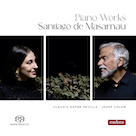
Claudia Dafne Sevilla & Josep Colom: Santiago de Masarnau: Piano Works
Eudora Records
Pianists Claudia Dafne Sevilla and Josep Colom have done a remarkable service not only to Santiago de Masarnau (1805–1882) for resurrecting his long-neglected music but to modern-day listeners for introducing them to material distinguished by refinement and lyricism. Contemporary pianists also are indebted to the pair for presenting them with a wealth of material they might newly consider adding to their repertoires. The physical release comprises three discs lasting almost three hours, and while it's not the definitive word on the music—no recording ever is—it will register as such until interpretations by other pianists emerge to challenge it. Masarnau's credited with infusing nineteenth-century Spanish music with European Romanticism, and the music on the multi-disc set repeatedly bears this out.
Sevilla also contributed liner notes to the release, which admittedly focus more on the figure than the works; such a choice makes sense, however, when the composer is so obscure. She begins by recounting his 1825 arrival in Paris and his rapid immersion within its cultural milieu. He voraciously consumed the music of his contemporaries and their precursors and developed a close relationship with Rossini. After a year in France, he moved to London, where musical connections were also forged and his aesthetic sensibility crystallized. Simplicity became a musical virtue he embraced and with it an intimate character associated with Romantic pianism. A relationship with the pianist Charles-Valentin Alkan and, through him, Chopin influenced Masarnau's intimate style too. Something else for which he's recognized in Spain is for establishing the first Conference of Saint Vincent de Paul in the country. After he returned to Spain in 1843, he founded the first Conference in Madrid in 1849 and thereafter channeled his energies less into music than into dedicating himself to those in need.
Like Masarnau, Sevilla has strong musical ties to both France and Spain: she has a Master's degree from Paris-Sorbonne University but also a second Master's from the Alicante Conservatory. Since 2021, she's taught at the “Tomás de Torrejón y Velasco” Professional Conservatory of Music in Albacete, Spain. Early in his career, the Barcelona-born Colom gained recognition in Spain as a winner of competitions and recipient of awards. He also holds a connection to Paris as he lived there during the ‘70s while studying at the city's École Normale de Musique. Today, he performs regularly with Spanish orchestras but also as a recital soloist and chamber musician, and by his own admission feels more at home in the latter contexts. While the performances are split between the pianists (the majority by Sevilla, however), they both naturally appear on La Melancolía, Notturno Patetico for Piano Four-Hands. A few other details are worth mentioning: first, many of the pieces are long odysseys, some even venturing beyond the sixteen-minute mark; second, two versions of Le Parnasse appear, one carrying the Op. 1 designation and the other Op. 10 and each featuring nine short movements, with one alteration in ordering from one to the other (clarification by Sevilla as to how and why there came to be two versions would have been welcome and helpful).
That aforementioned principle of simplicity permeates the three Ballades with which the set opens, the lyrical first, “Invraisemblable, mais ... historique” (“Invisibly, but... historical”), fusing European and Spanish Romanticism into an eloquent expression. Executed by Sevilla with the same kind of technical elegance and emotional refinement she brings to all of her performances on the release, the first Ballade is a splendid harbinger. Even more intimate (but also playful) is the second, titled “Maria” and again rendered exquisitely by Sevilla; a piece so haunting would seem to be tailor-made for a solo pianist's recital encore. Understandably solemn is the third Ballade, its “Découragement” (Discouragement) title mirroring its disposition. Colom effectively articulates the material's longing and melancholy in his probing examination and the suppleness of his touch. A fourth Ballade, this one in A-Flat Major and again performed by Colom, is a jauntier affair, though the music gravitates into other areas during its ten minutes, some episodes regal and others inward-looking. The four-hands work that concludes the first disc shows the pianists to be synchronized in both their playing and sensibilities as they jointly essay the piece's many twists and turns.
Disc two opens with the first iteration of Le Parnasse and Sevilla navigating her way through its cycle of piano waltzes with characteristic poise. With nine parts (titled after the Muses from Greek mythology) squeezed into fourteen minutes, the scenery changes quickly as one dance-based expression cedes its place to another. Some exude a light, salon-like character that in no way lessens their appeal (the spirited second, “Uranie,” and jovial third, “Melpoméne”), and some are disarmingly pretty (the seventh, “Clio,” and eighth, “Calliope”). Longer explorations such as La Fosanica and La Ilusión, Fantasía de sentimiento adopt a theme-and-variations approach, the theme in the former reported to be by Rossini and the second based on material by Antonio de Cabezón. Sevilla handles the stylistic transitions in each with aplomb, with La Fosanica veering from florid to frenzied at a moment's notice and La Ilusión, Fantasía de sentimiento affecting in its romantic dignity. In between her renditions, Colom's thirteen-minute account of the incandescent L'Innocente, Polacca is both breezy and authoritative.
The third volume starts with a second (and slightly longer) run-through of Le Parnasse, with Sevilla at the controls and “Thalie” now before “Melpoméne,” before concluding with a trio of long pieces, Rondino Brillante, La Ricordanza, and Fantasia, the first two performed by Sevilla and the third Colom. Why a second run-through of Le Parnasse is included isn't clear, but there's no disputing the charm of its fifth and sixth parts, “Terpsichore” and “Erato.” The same might be said of the delightful, miniatures-filled Rondino Brillante, whereas La Ricordanza calls on Sevilla's formidable technique when its sunny theme's delivered in a dazzling array of ripples, trills, and cascades. Colom gets the last word with his own sixteen-minute travelogue, the aptly titled Fantasia, and shows himself wholly capable of meeting its own technical challenges.
The value of the release, recorded during September 2023, is greatly enhanced by the fact that all of the works are first-ever recordings; that material of such high quality has never before been available in a recorded form is a mystifying wrong now righted. It hardly surprises, then, that Masarnau's name has been known to so few, but perhaps that will now change, thanks to Sevilla and Colom.June 2026