

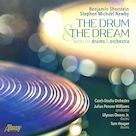
Benjamin Shorstein & Stephen Michael Newby: The Drum & The Dream: Works For Drums & Orchestra
Albany Records
Piano, violin, and cello concertos are abundant in the extreme, whereas works featuring drums are anything but. That makes these pieces by Benjamin Shorstein and Stephen Michael Newby all the more welcome, with the former's Concerto for Drums and Orchestra a textbook example of the concerto form and the latter's Symphony No. 2 a work that integrates the drummer more seamlessly into the ensemble. Regardless of the differences between the works, drummers who aspire to perform with orchestras will salivate at the prospect of having these pieces in their repertoires. Both are played by the Czech Studio Orchestra and conductor Julius Penson Williams, with Ulysses Owens Jr. manning the drum chair in the Shorstein work and Tom Hooper doing the honours in the other.
Shorstein is not only an American composer and pianist but a percussionist too and thus well-groomed to fashion a concerto that allows a drummer to shine. The score he created was purposefully designed to encourage the soloist to interact freely with the ensemble and give free rein to the drummer's improvisational skills. Its plan is consistent with the direction his music often takes when it fuses improv with formally notated passages. Testifying to his daring is a jazz treatment of Schubert's Winterreise, which the Chicago Tribune named one of 2020's top jazz albums.
Concerto for Drums and Orchestra was written expressly for Owens Jr., and the three-time Grammy Award-winner rises terrifically to the occasion. Presented as a single-movement work lasting fifteen minutes, the concerto couples an orchestral score that's notated with a drum part that's largely improvised. The piece challenges the soloist whilst ensuring that every performance of the work is unique. The soloist doesn't entirely lack for direction, however, as the orchestral component provides guidance and a framework to which the drummer responds. Like a traditional concerto, Shorstein's works an extended cadenza into the piece's centre that grants the soloist complete freedom. After the work stomps into position, Owens Jr. accompanies the orchestra with authority, punctuating its playing and matching its dramatic theatrics step for step. Ample space is left for interjections by the soloist in a piece that's often aggressive, eruptive, and bursting with energy and activity.
Newby's Symphony No. 2 is an entirely different animal, given that it's a secular liturgical piece dedicated to gospel composer Andrae Crouch and thus a hybrid of Western classical and African-American idioms. Like Shorstein, Newby's a composer but much else besides. The Detroit native has served as Minister of Worship at Peachtree Presbyterian Church in Atlanta and is currently a Professor of Music and Ambassador for The Black Gospel Music Preservation Program at Baylor University. Holding degrees in music and theology, Newby served for over thirty-five years in church music ministries in Michigan, Massachusetts, Washington, California, Georgia, and Texas. Presented in three parts and lasting approximately eighteen minutes, the symphony progresses through “Declaration,” “Dream,” and “Dance” movements, each one generally hewing to the tone intimated by its title.
Unaccompanied oboe introduces “Declaration” with a hymnal chant the orchestra elaborates upon, with Hooper animating the music's drive and the short movement culminating in a majestic statement of the theme. The symphony's longest movement, the central episode delivers its sermon across ten minutes. Flowing passages during its opening section establish a dream-like ambiance until the music picks up energy and blues-tinged horns announce a shift in tone. Piano-driven flourishes add a subtle folk-gospel character, with drums largely exchanged during this passage for percussion. As the movement approaches its end, the orchestra swells grandly, as if anticipating the robust “Dance” finale to come. In it, the music's at first hymnal before rising to gospel-driven fervour, piano, horns, tambourine, and drums working in tandem to deliver the affirmation.
At slightly more than thirty-two minutes, the release is compact for a full-length but rewarding nonetheless. Certainly concertos and symphonies where a drummer's featured prominently are rare, and the value of each work is enhanced as a result. Owens Jr. and Hooper capitalize on the opportunities Shorstein and Newby have granted them and may very well entice other drummers to tackle the works to impose their own personalities upon them, Shorstein's especially inviting in that regard.September 2026