

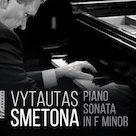
Vytautas Smetona: Piano Sonata in F Minor
Navona Records
The road that brought pianist Vytautas Smetona to this release has been long and winding indeed. He was born in Cleveland, Ohio after his parents' 1941 emigration to the United States helped them escape the Soviet invasion and Lithuanian occupation. Taught principally by his mother and brother (both experienced pianists), Vytautas made his New York debut at Town Hall in 1976 and went on to deliver more well-received concerts as a solo pianist and orchestra soloist. After issuing his debut recording, Vytautas Smetona Plays Chopin, Liszt, and Rachmaninoff, in 1979, his life took a dramatic turn when four years later he chose to return to school and channel his energies into non-musical areas.
Still, his love for music never waned and sure enough he returned to it, beginning with the release of the album All the Way Back in 2015 and then a New York recital, his first in over three decades. Flexing his artistic muscles even further, Smetona augmented his playing with composing and after writing a number of original works has now released the self-composed Piano Sonata in F Minor, written between January 2017 and March 2022 and, it turns out, a tremendous vehicle for his dynamic pianism. Three more years would pass until the formal recording of the work in August 2025 at Steinway Hall in Cleveland.
There's certainly nothing slapdash about the piece; rigorously conceived and structured, its four parts are an intense consolidation of Smetona's artistic energies. No one will mistake it for an atonal expression indebted to the Second Viennese School. In fact, its creator clarifies as much in describing the musical aesthetic informing the sonata's creation: extensive use of counterpoint and polyphony; the desire to create thematic material of beauty and distinction; and harmonic language that, in his words, “does not stray beyond that used by Johannes Brahms.” In grounding itself in such principles and in deploying an arresting four-note motif (F, C, D-flat, E-flat) as a unifying thread, the four-movement sonata is branded as a Romantic work and proudly so.
Smetona's own text offers a moment-by-moment exegesis of the development in all four movements, but attending to it isn't required for the work to be appreciated and enjoyed. Suffice it to say, the motif emerges throughout in different forms, and the piece itself doesn't stray too far from tradition in advancing from a mighty sonata-allegro to a gentler andante, spirited scherzo, and a concluding movement that includes aspects of both passacaglia and fugue. The work, which frames two short movements with two longer ones, begins with a twelve-minute “Andante - Allegro,” the motif introduced early and played three times in succession, starting on a lower pitch each time. The opening movement charts a dramatic course from the outset, even if a tranquil passage softens its impact in the early going. The repeated voicing of the motif imparts stability, but attention's redirected from it by a lyrical, Brahms-styled statement that's repeated too. Grandiose declamations of the motif shift the focus back again, especially when articulated emphatically by the pianist, but, refusing to be denied, the lyrical part wrests the attention away from it once more.
Tonally, the oft-pretty “Andante con Moto” departs from the opening movement, yet there is a structural overlap when four-note sequence re-appears, albeit in transfigured form—the connection present but indirect and subtle. A rhapsodic central section imparts a soothing quality to the music, while single-note patterns bring an elegant dance-like feel to the trills-ornamented presentation. The scherzo-styled third movement picks up where the second leaves off but now at a naturally faster clip and with fleet-fingered passagework generating momentum. A detour into a more lyrical realm occurs midway through before the music shifts back to impish, almost march-driven declamations. Distancing itself from the others, the “Moderato” movement comprises a theme and twenty-two variations. A tie to what's come before is sustained, however, when the motif from the first movement re-surfaces as the opening part of the theme (the motif repeatedly interjects in its four-note form too). The variations extend from florid and lyrical to boisterous and freewheeling (even Gershwin-eque), the movement consequently registering as an elaborate and diverse meditation on a theme.
In featuring a single work only (a conventional full-length would have coupled it with one or two more compositions), Smetona's release ensures the focus remains strictly on the sonata. The release doesn't suffer as a result, however: its compact, thirty-eight-minute duration isn't unwelcome, and there's definitely something appealing about a release that concentrates on one fully realized statement. Yes, Smetona's piece is very clearly grounded in tradition, but its appeal is bolstered in being a wholly personal expression and one meticulously developed.July 2026