

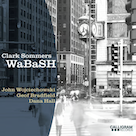
Clark Sommers: WaBaSH
Calligram Records
Shilling decades ago for a California company, Orson Welles popularized the catchphrase “We will sell no wine before its time,” words that spring to mind when confronting this debut release from Clark Sommers' WaBaSH. The quartet has existed in various configurations since the late ‘90s yet is only now sharing its music beyond the club stage. Regarded as one of Chicago's most renowned working bands, its self-titled debut makes for compelling listening when the bassist's joined by drummer Dana Hall and tenor saxophonists Geof Bradfield and John Wojciechowski, the former also credited with soprano sax and bass clarinet and the latter alto sax and flute. There's no sweeter sound than when their saxes wail together (at the conclusion of “Points of Reduction,” start of “That Was Then,” and midway through “Close the Loop,” to cite three examples), but the album also benefits when they expand the quartet's sound with bass clarinet and flute textures (as happens during Bradfield's “Contemplation”).
WaBaSH is itself a confluence of two bands, BaSH, a trio comprising Sommers, Bradfield, and Hall that issued a release under that name in 2013, and Hall's spring, a quartet featuring Wojciechowski. With all four players sharing long histories, the music presented on WaBaSH exhibits a remarkable degree of chemistry, such that one hears Hall, for example, responding to and anticipating the playing of the others with seeming telepathy (by way of illustration, see Wojciechowski's “Group Solitude”). One of the outing's primary pleasures is witnessing in action the deep connections the four have clearly forged over many years (consider, for example, the abrupt change-up that occurs in “Kasbah” when the band collectively shifts into swing mode). The rapport is so strong, the performances are often gripping.
The album's issued under Sommers' name, and admittedly five of the ten tracks are his (two of them unaccompanied bass intros, however). But as the other three also contribute pieces—two in Wojciechowski's case—the release registers as a more balanced proposition than one dominated by a single individual. Rounding out the set, captured at Chicago's Pro Musica on November 23, 2025, is a cover of Dave Brubeck's “In Your Own Sweet Way.” Other inspirations also seep in, with Ornette Coleman explicitly referenced, for instance, by Wojciechowski in his aptly titled “Ornette-Type-Tune.”
It takes no time at all for the band's punchy persona to coalesce when Sommers' “Points of Reduction” slinks into position, the saxophonists purring and coiling around each other and the others quickly crafting a robust groove. The four ease into the performance confidently, the saxophonists voicing the tune's theme in unison before solos take over, Wojciechowski wielding his alto acrobatically and Bradfield sneaking in behind him on tenor to perpetuate the bluesy feel. Clocking in at eleven minutes, the tune allows the band ample room to maneuver and dig into the material. The alto-tenor combination proves as effective in the bassist's “Close the Loop,” the feel more soulful than bluesy and the groove elastic yet still tight. With the advent of Hall's “Kasbah,” the mood shifts into a more exotic zone, its air of mystery intensified by the serpentine presence of soprano sax in the arrangement.
The album ends with the one-two punch of “In Your Own Sweet Way” and “Ornette-Type-Tune” (don't be thrown by the incorrect track sequencing on the physical copy), the Brubeck classic receiving a fresh make-over when soprano and tenor saxes entangle and the spirited Coleman homage evoking the Texan legend's glory days with Cherry, Haden, and Blackwell. There's no grandiose manifesto or highfalutin concept in play on WaBaSH, just quartet playing pitched at a high and consistently engrossing level. Building on the enduring foundation of jazz tradition, the four need do nothing more than play for the recording to make a strong impression.September 2026