

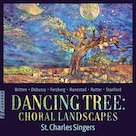
St. Charles Singers: Dancing Tree: Choral Landscapes
Navona Records
Comprising live-in-concert recordings captured at Baker Memorial United Methodist Church in St. Charles, Illinois between 2018 and 2025, Dancing Tree: Choral Landscapes makes the strongest argument possible on behalf of The St. Charles Singers and its founder, conductor, and Music Director Jeffrey Hunt. The expressive beauty of the American chamber choir's sound is captured in works ranging from early twentieth-century pieces to contemporary ones. Those by Britten and Debussy sit comfortably alongside world-premiere recordings of commissioned pieces by Jake Runestad and Charles Forsberg. The set begins on a high with Sir John Rutter's eight-song cycle Dancing Tree, rendered even more resplendent by the inclusion of harpist Erin Freund. In other settings, cellist Jean Hatmaker, double bassist Joe Policastro, and pianist Stephen Uhl join the choir to make the ensemble's a cappella offerings even more special.
Operating out of St. Charles, Illinois, the mixed-voice chamber choir is now in its fourth decade (it began in 1984 as the Mostly Madrigal Singers) and has established itself as one of the country's leading vocal ensembles, with American Record Guide, for example, calling it "a national treasure.” Comfortable delivering early classics and contemporary material, the group is known for its versatility, immaculate blend, and impeccable musicality.
The London-born composer and choirmaster Rutter (who's also conducted the choir on many occasions) leads us into the ensemble's world with Dancing Tree, composed in celebration of the group's fortieth year and based on the poetry of Charles Causley. Each of the eight texts has a strong association with nature and folklore and consistent with that reflects the composer's abiding affection for English folk music. The work engages immediately with the melodically alluring “Stone in the water,” its gentle lilt enhanced beautifully by Freund's harp. Sung by the choir's female singers, the opening movement gives way to “Foxglove,” male singers initially featured before a reprise of “Stone in the water” brings the full choir into the performance. With Chloe Hayes soloing, “In my garden” stands out as a particularly magical moment within the work; “Dandelion,” on the other hand, is striking for its chromatic daring and playful spirit. Charmingly irreverent too are the folktale-styled “Daniel Brent” and “Spin me a web, spider”; the tonal scenery changes for “I am the song,” which ends the work on a moving, reverential note. It's hard to determine whether Rutter's composition or the choir's rendering is more beguiling when both are so winning.
Set to a poem by the English writer Mary Elizabeth Coleridge, Charles Villiers Stanford's late-Romantic choral setting “The Blue Bird” holds special meaning for the group as it was one it sang outside during the pandemic—in a forest preserve, appropriately enough, where birds sometimes mingled with their voices. Oft-performed by the group and delivered with finesse, Stanford's art song exudes a majestic poise that makes it all the more affecting. Injecting a brief smattering of whimsy into the recording is Charles Forsberg's “Buttercup Days,” a movement taken from In Christopher's Time: Jazz Suite for Choir. Based on A. A. Milne's Winnie-the-Pooh poetry and coupling the choir with bassist Policastro and pianist Uhl, the Hundred Acre Wood-set piece makes for a brief yet nevertheless riveting mid-album ballad.
Working with texts by Charles d'Orléans, Debussy crafted Trois Chansons for unaccompanied choir, and the composer's inimitable sensibility is audible at every moment in exquisite settings ranging from a love song (“Dieu! qu'il la fait bon regarder!”) and spirited dance (“Quant j'ai ouy le tabourin,” Brian Jozwiak impressing as the soloist) to a depiction of winter as cold and villainous (“Yver, vous n'estes qu'un villain”). The nature connection asserts itself immediately in Britten's three-part Hymn to St. Cecilia when it opens with W. H. Auden's words "In a garden shady this holy lady” and then blossoms into a florid choral tapestry extending for a full ten minutes. At album's end and set to texts by Todd Boss, Runestad's four-part Cello Songs moves us through the seasons, the choir joined again by Uhl but most prominently cellist Hatmaker. Her sweetly singing, vibrato-rich bowing elevates the work as it advances from the serenading splendour of “Summer” to the encroaching melancholy of “Fall” and “Winter,” the former defiant and the hermetic latter resigned. Rather than end on a dour note, Runestad smartly sequenced the movements so that the swinging, bebop-inflected spirit of “Spring” would be the last sound heard.
While the six works on the release share a connection to nature, the listener leaves Dancing Tree: Choral Landscapes more captivated by the compositions and the performances than the overarching theme. Regardless, anyone planning a visit to St. Charles, Illinois would be well advised to attend one of the a cappella ensemble's concerts in order to experience the glories captured on the album firsthand.October 2026