

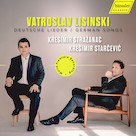
Krešimir Stražanac& Krešimir Starcevic: Vatroslav Lisinski: Deutsche Lieder / German Songs
Hänssler Classic
Could a bass-baritone's voice be any more expressive than Krešimir Stražanac's? His latest recital with pianist Krešimir Starcevic (the duo debuted with a 2024 collection of songs by Croatian composer Blagoje Bersa) suggests no one comes close to matching the Croatian singer, who distinguishes every one of the release's eighteen songs with his luxurious tone. Collaborating with pianist Doriana Tchakarova, Stražanac dazzled on his 2025 rendering of Schubert's Schwanengesang and does so now with Starcevic in their world premiere recording of material by Croatian composer Vatroslav Lisinski (1819-54). The texts on this release are German, but Lisinski also set songs in Croatian and Czech, material that Stražanac and Starcevic might feature on a future release. For now, their Deutsche Lieder / German Songs offers a superb sampling of the composer's art.
An international success story, Stražanac's reputation precedes him. He's performed with the Zurich Opera, Berlin Philharmonic, Frankfurt Opera, Los Angeles Philharmonic, and Bavarian State Opera and appeared in productions of Stravinsky's Oedipus Rex, Telemann's Orpheus, Puccini's Turandot, Strauss's Ariadne auf Naxos, and others. His fondness for rarely performed operas is also seen in his choice of lieder, such that one release might see him highlighting Schubert and another the lesser-known Bersa. The recipient of multiple awards, Stražanac is as comfortable performing Baroque repertoire as he is contemporary pieces.
Lisinski's life was short, but he nevertheless produced a substantial body of material during his abbreviated tenure. Included in the 160 preserved works are operas (including the first Croatian national opera), choral and orchestral settings, piano pieces, and art songs. Whereas his Croatian songs were produced over a lengthy span, those he composed in German were mostly written in 1846, with a smaller number between 1846 and 1851. Regardless of the language in which they're set, Lisinski's songs breathe the air of early Romanticism. However circuitously it flows, a through-line can be drawn from Schubert to him, which makes Lisinski an ideal choice of follow-up to Schwanengesang. Starcevic shows himself to be an exceptionally sympathetic partner, a pianist sensitive to Stražanac's every gesture and inflection. The clarity of Starcevics articulation provides a consistently solid ground for the expressivity of the vocalist.
He engages immediately when “Die Botschaft” (The Message) begins the set with a series of passionate exchanges between a poet and his beloved, the vicissitudes of their communication reflected in music ranging from tender declaration to desperation and anguish. At almost seven minutes, the song's so encompassing it could stand for the recording as a whole, but there's much more beyond that opening statement.
Stražanac gives affecting voice to the sorrow felt by lovers separated by distance during “Liebe und Ferne” (Love and Distance). Longing of a different kind's articulated in “Der liebe Stern” (The Star of Love) when an unattainable object of adoration is gazed upon by a subject at a nocturnal setting. As expressive is the story-telling “Der Zufluchtsort” (The Refuge), wherein death is personified by a kind old man who offers shelter to a beggar; while the latter eventually dies, death is treated here as a peaceful end as opposed to something harrowing and horrible. Stražanac's control and poise and the slow, measured pace of the song's delivery identify it as one of the release's more exquisite offerings. Contrasting markedly in tone, the march-driven “Das herbste Wort” (The Harshest Word) and “Abreise” (Departure) make one long to hear the singer emoting in a Brecht-Weill context.
A hint of tone-painting emerges in “Der blinde Fischer” (The Blind Fisherman) when the piano's rolling lilt suggests the motion of waves and Stražanac captures the angst the titular figure feels upon concluding that a life of blindness is worth less than death itself. From the collection Des Knaben Wunderhorn, made famous by Mahler, comes “An die Tanne” (To the Fir), a poised (if fleeting) meditation on the dual nature of love. Elsewhere, Stražanac's heartfelt in “And die Frühlingswinde” (To the Spring Winds) and elegiac in “Das Paradies” (The Paradise).
Leave-taking's addressed in many a song, be it “Lebewohl” (Farewell) or the trio of songs with which the recording ends, the sombre “Einsame Träne” (A Lonely Tear), wistful “Ins wärmere Land” (Into a Warmer Land), and “Abschiedslied” (The Parting Song), its at times sunny tone far removed from the resignation of Mahler's similarly titled “Der Abschied” from Das Lied von der Erde. As noted by Domagoj Maric in his booklet commentary, transience is the overriding theme of these German-set songs, with Lisinski repeatedly lamenting the loss of love, homeland, and health. Despite such subject matter, the album's neither dour nor depressing when it's illuminated by the inimitable vocal presence of Stražanac and the sparkling Steinway accompaniment of Starcevic.August 2026