

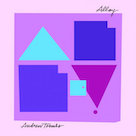
Andrew Toombs: Alloy
Shifting Paradigm Records
At twenty-six minutes, Andrew Toombs' debut as a leader is concise in the extreme, and certainly more material wouldn't have been unwelcome. What's on Alloy is nevertheless very satisfying, especially when its musical content is not perhaps what one might have anticipated. At its core, the band's a trio comprising Toombs on piano, organ, and keyboards (plus drums on “Beyond,” what he characterizes as his "acoustic tribute to electronic music”), Junius Paul on bass, and Makaya McCraven drums, which would suggest, perhaps, a release aligning to the classic jazz piano trio tradition. Yet while there are moments of jazz, Toombs' album veers as often into funk, electronica, and hip-hop territories.
The Cincinnati-born Toombs is no unseasoned talent fresh out of Berklee but rather someone armed with two decades of experience as a sideman and collaborator. This classically trained prodigy was performing professionally by the age of eleven and as a teenager appeared with the Cincinnati Pops and Cincinnati Symphony Orchestras. He later did, in fact, attend and graduate from Berklee College of Music, in 2007, before establishing himself as a pianist comfortable in any number of stylistic contexts.
Testifying to his versatility, Toombs has performed with everyone from Carole King, Kenny Rogers, and Faith Hill to Common, Bootsy Collins, Benny Golson, and Dave Brubeck. With Alloy, he steps into the spotlight, though true to his character he shares it with others, and not just Paul and McCraven but also guest trumpeters Maurice Brown and Marquis Hill and Grammy-winning poet J. Ivy, who graces “Moodism" with a spoken word turn. The album title was chosen purposefully to reflect that collaborative approach, given that an alloy results from the combination of two or more metallic elements.
Drawing for inspiration from the “calm, wonder, and natural beauty” (Toombs' words) of Ontario's McGregor Bay, “The Slot” makes for a sultry way into the album, what with Hill's muted trumpet purring alongside the leader's lyrical piano voicings and his rhythm team's crisp flow. Listeners familiar with the trumpeter's own fine solo releases will cotton to his alluring guest shot here with no difficulty whatsoever. Hill's one of those musicians who elevates every recording on which he appears, and that's certainly true here.
Titled after the Cincinnati street where Toombs grew up, “Marlou Lane” scales the arrangement back to piano trio for a rare foray into acoustic jazz. Nostalgia and affection ooze from this heartfelt homage to his youth, and his freewheeling solo, which weaves hints of gospel into its soulful expression, testifies to his ample skills in that department. Delivered at a furious clip, “Off to the Races” likewise shows the trio's capacity for high-wire jazz—even if for only a minute. Grooving hard is “Unexpected Party,” which finds McCraven's swinging funk groove coupling with electric piano in a fresh take on jazz-funk.
On an entirely different tip, “Subconscious” sprinkles neon synthesizer burblings across a fluttering bass-and-drums foundation. McCraven's skipping funk pulse and Toombs' organ drive “Past Souls” memorably—a shame the track's a mere thirty-five seconds. With the trio augmented by trumpeter Brown and J. Ivy, the aptly titled “Moodism” registers as one of the album's more memorable cuts when the ear-tickling spoken component's (“Dig deeper”) underlaid by a smooth hop-hop pulse and accented by Brown's considerable horn artistry.
Many of these nine tracks impress whilst also suggesting they could have lasted longer and developed further. The album's short running-time might suggest an artist stepping into the ring tentatively; there's nothing about the performances themselves, however, that's tentative: Toombs appears wholly sure of himself on Alloy as a player, leader, and composer.November 2026