

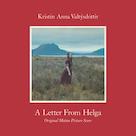
Kristín Anna Valtýsdóttir: A Letter From Helga
Sono Luminus
Even if you weren't aware before hearing A Letter From Helga that Kristín Anna Valtýsdóttir was once a member of the Icelandic outfit múm, the realization would quickly set in the moment her cover of John Cale's “I'm Not The Loving Kind” appears towards the end of the film soundtrack. The childlike vocals (one source calls her soprano “elvish”) that are so much a part of the múm identity appear in the Cale cover—a good or bad thing depending on how you feel about that style. Regardless, vocals appear on that song only, with the other seventeen pieces instrumentals created by Valtýsdóttir and a smattering of guests.
She's done much else since leaving múm in 2006. After appearing on three of the band's albums (and multiple EPs) and singing and playing accordion, saw, banjo, bass, and keyboards on its tours, she struck out on her own, moving to New York in 2006 and issuing music under the alias Kría Brekkan before returning to Reykjavík three years later. She's collaborated extensively with the artist Ragnar Kjartansson on a number of video works and installations, and it was he who encouraged her in 2015 to record the songs she'd written since her days with múm. Recorded with former Sigur Rós member Kjartan Sveinsson, the resultant album, 2019's I Must Be the Devil, received the best album award in its category at the Icelandic Music Awards and was re-released on CD by Sono Luminus in 2021 after its initial LP run on Bel-Air Glamour.
That same year, Valtýsdóttir created the film score for A Letter from Helga by director Ása Helga Hjörleifsdóttir, which, five years later, is now finally seeing release. Besides singing on the Cale cover, Kristín Anna plays accordion, pianos, marxophone, and synthesizer on the release, whose arrangements are credited to her and fellow Icelandic musician Davíð Þór Jónsson. The miniatures exude a ramshackle charm in their folkloric and homespun character that's not wholly unlike múm's, even if the soundtrack material emphasizes natural acoustic sounds and downplays electronic elements. The impression's fostered of Valtýsdóttir assembling the tracks bit by bit in a home studio and adding parts by musician friends who've dropped by to contribute to the project. Jónsson plays Hammond organ on "I'm Not The Loving Kind,” while Aki Asgeirsson adds cornett, Gyda Valtysdottir cello, and Ingi Gardar Erlendsson tuba, trombone, alto horn, and euphonium to select tracks.
Any soundtrack must be judged on its own terms, but some mention of the film's story merits mention for purposes of context. Set in the west fjords of Iceland during the 1940s, the story revolves around the farmer Bjarni, his wife Unnur, and Helga, a mother of two who lives on a neighbouring farm and who is impregnated by Bjarni after an affair develops between them. A scan of the track titles aligns with that synopsis, such that one could visualize the narrative unfolding as each part of the soundtrack plays.
Kristín Anna's classical piano training brings a refined quality to the cello-enhanced “Opening” and the lilting solo piano settings “Glahn” and “Golden Age.” While no will mistake her writing for Michael Nyman's, there are moments where the music (see, for instance, “Love” or “The Letter”) calls The Piano soundtrack to mind. Hammered dulcimer-like textures and a mournful horn distance “Desire” from the other vignettes. Some pieces are so short they register as more sketches than full-formed compositions, “Arrival of Spring” a mere wisp of a thing. Still, though the tracks are concise, one such as “I'm Pregnant” is long enough for its air of ominous portent to be heard. Tension's palpably felt in the fleeting “You Don't Have Much Time” and accelerating “Where Are You Going,” while an almost unstoppable feeling of urgency's conveyed by the haunting "Hay cutting.” Whereas an aura of impending doom permeates “Drowning,” the lullaby-like, organ-warmed presentation of “I'm Not The Loving Kind” adds a fragile hint of hope, even if darker undercurrents are still audible. The release is a short one at twenty-seven minutes, but its contents are never less than engaging.September 2026