

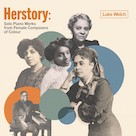
Luke Welch: Herstory: Solo Piano Works from Female Composers of Colour
Luke Welch
On earlier albums, Toronto-based pianist Luke Welch alternated between releases featuring material by classical composers Schubert, Schumann, Scarlatti, Chopin, and Beethoven and Black American artists R. Nathaniel Dett and Samuel Coleridge-Taylor. His latest, Herstory, aligns itself to the latter category in presenting works by female composers of colour, from Florence Price and Montague Ring to Chiquinha Gonzaga, Estelle Ricketts, and Lady Viola Kinney. A resurgence of interest in Price's music has returned her to the spotlight during the past decade, but the other figures are less well-known to the general public and thus benefit from their inclusion on Welch's release.
It is, in certain respects, a modest album, which turns out to be a key part of its charm. In place of epic piano concertos or sonatas lasting twenty to thirty minutes, we have instead miniature-sized pieces lasting one to four minutes, and while two suites do appear, their parts are again modest in duration (only three of the fifteen tracks push past four minutes). As Welch plays, one visualizes him less on a formal concert stage than at an intimate salon setting crowded with rapt listeners or even in a family's living room, Welch at the piano captivating those hearing him play. Sweeping moments of Wagnerian grandeur are eschewed for pieces that communicate with plainspoken directness and engage for their honesty of expression. While the material exudes the elegance of classical form, it also entices for the folk melodies that ground many a piece. There is, in short, a warmth and humility to the music that makes it extremely appealing.
Recorded in Kingston, Ontario in February 2026, Herstory is the sixth full-length from Welch, who grew up in Mississauga and studied at Western University in London, Ontario and Codarts Rotterdam University for the Arts in the Netherlands. He's performed around the globe as a solo pianist and with numerous orchestras and is also a sought-after accompanist who's worked with the Dutch National Ballet and National Ballet of Canada. When not performing and recording, Welch serves on the Faculty of Piano at York University in Toronto. Included with this attractively presented release is a booklet featuring brief bios of the composers and commentaries on the works performed.
Herstory starts with two scene-setters by Price, the pedagogically conceived Etude dazzling with furiously paced patterns Welch executes with consummate skill. Perhaps more representative of her music is Memory Mist, written in 1949 and a lovely, folk-tinged wedding of African-American and Western European idioms. It's, like much of what's here, short yet still long enough for its melodic allure to register; it also extends far enough to accommodate bright melodic episodes and a central one that's slightly more reflective. Hailing from Rio de Janeiro, Francisca (Chiquinha) Gonzaga is represented by four concise works, beginning with Atraente, which, “attractive” in Portuguese and composed in 1877, merges multiple elements, including polka, ragtime, and Brazilian, into an enticing expression that's said to have birthed the “choro” genre. As charming are 1878's Sultana and waltzes from 1884 and '86, Walkyria and Granta Esperanca (Pleasant Hope), respectively.
From London, England and the daughter of an African-American father and Swedish mother, Amanda Aldridge adopted the pseudonym Montague Ring when she transitioned from singing to composing. Both of the suites featured here were published in 1927 and find her merging Romantic salon music, African elements, and African-American music into compelling, multi-faceted works. Whereas Four Moorish Pictures: An Eastern Suite advances from the hushed rumination “Prayer Before Battle” and ominous “Twilight Dance” to the rambunctious "Dance of Triumph,” T'Chaka: African Suite wends from the sternly militant “Before the Battle” to the gently rhapsodic “Monarch” and insistently percussive "War Dance.”
The set concludes with Mother's Sacrifice by Missouri-born Lady Viola Kinney, a heart-warming, 1909-published expression that's marked by a constantly rising trajectory, and Estelle Ricketts' endearing Rippling Spring Waltz, the only known surviving composition by the American composer. Herstory is an immensely satisfying affair not just for presenting works that have been either too little performed or not previously available in a recorded form but for providing another stellar account of Welch's pianistic artistry. Listening to him play, here on a Steinway Model D piano, is always a pleasure.September 2026