

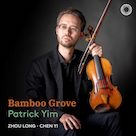
Patrick Yim: Bamboo Grove
Pentatone
Blossoming like a Lotus flower, Bamboo Grove advances from Zhou Long's titular work, featuring violinist Patrick Yim alone, to Chen Yi's Suite for Viola and Chamber Winds (2012), its four parts performed by a ten-member ensemble, including conductor. Four world-premiere recordings are presented on Yim's hour-long set, which effects a compelling fusion of Chinese and Western musical traditions. This was no project conducted from afar: a week-long residency at the University of Notre Dame in April 2024 enabled the violinist to work with Long (b. 1953) and Yi (b. 1953) in person on their respective pieces.
Rehearsals, recording sessions, and informal conversations between the participants made for a resonant experience and helped inspire the musicians to deliver performances of great power. Yim was able to learn first-hand about the composers' experiences during the Cultural Revolution and their studies at Beijing's Central Conservatory of Music and New York's Columbia University. Their vast knowledge of Chinese folk traditions blends with their command of Western compositional techniques, such that Yim's violin and viola and the Western instruments of his musical partners evoke connections to ones central to traditional Chinese music, including the guqin, pipa, and xiao. An ever-entrancing world of timbres conjures a vivid realm that straddles cultures and feels both ancient and new.
Yim's commanding, eleven-minute treatment of Long's Bamboo Grove (2024) introduces the recording. Inspired by Ruan Xian, one of the Seven Sages of the Bamboo Grove and a longstanding embodiment of artistic freedom, the work advances through two contrasting sections, the first, “Bamboo,” conjuring the vision of the sage wandering among bamboo, the mood contemplative and the pace unhurried. Aggressively plucked strings alternate with fluid, intensely bowed figures, some warbling at the uppermost register and others dive-bombing far below. Seamlessly transitioning into “Beats,” Yim's playing intensifies in activity and exudes a folk dance-like character in its thrust. Alternations between pizzicato and rapid-fire bowing pervade this part too, with the violinist's playing growing ever more furious and impassioned.
On Yi's Xian Shi (1982), the viola-wielding leader's joined by pianist Shuai Wang and percussionist Paul Vaillancourt, the trio version performed here later converted by the composer into a work for viola and orchestra. Written at the Central Conservatory of Music for Yi's 1983 graduation concert, the piece is both grounded in folk tradition and daringly experimental. Rumbling dynamically into position, the work finds the violist dancing amidst loud percussive and piano flourishes. When not barreling forth with virtuosic displays, Yim delivers lyrical string melodies that call to mind the stately formality of Chinese classical music, with Vaillancourt's percussive timbres evoking a like character; Wang's declamations, on the other hand, seem more emblematic of Western writing. Regardless, the music's unfailingly dynamic, and with all three players attacking the material with gusto the performance explodes with energy.
For Long's Tales from the Nine Bells (2013), Yim's violin is augmented by Kirsten Docter's viola, John Diodati's clarinet, and Wang's piano. Drawing on a millennia-old Chinese legend, the work initially unfolds at a less intense pitch than Xian Shi, opting instead for atmospheric scene-painting punctuated by a field of entwining sonorities and ethereal textures. Gradually, however, the pace quickens and the interactions between the instruments swell in density. In one episode, florid violin patterns cycle alongside percussive hammering from the piano; in another, animation's exchanged for introspective contemplation and an almost eerie stillness. Of the four works presented on the release, this one's perhaps the most enigmatic.
The recording culminates in its most elaborately scored setting, Yi's Suite for Viola and Chamber Winds (2012), with the Paul Hostetter-conducted nonet comprising Yim, Diodati, Vaillancourt, Catherine Ramirez (flute), Jennet Ingle (oboe), Anna Marsh (bassoon), Matthew Oliphant (horn), Charles Roberts (trumpet), and Riley Leitch (trombone). Titled after a mouth pipe organ played in village groups, “Lusheng Ensemble” initiates the suite on a blustery note, the movement drawing much of its impact from the rich timbral range the chamber unit generates. The ringing of Chinese bells immediately separates “Echoes of the Set Bells” from the other parts, as does counterpoint between the percussive instrument and the viola. Vividly emblematic of traditional Chinese music, “Romance of Hsiao and Ch'in” is distinguished by the lyrical voice of the viola and the expressive orchestral backdrop it emotes against. Ending the suite on an exhilarating note is the fiery “Flower Drums in Dance.”
Even if one's musical taste were not to run to Western-Eastern fusions of the kind presented on Bamboo Grove, one would still come away riveted by the performances, all four of which are inspired in the extreme. Yim and company tackle each piece with total conviction and make the strongest case possible for the material on offer. The playing by him and his colleagues is at an ordinarily high level and factors dramatically into the memorable impression the recording leaves.September 2026