

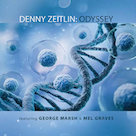
Denny Zeitlin:
Odyssey
Sunnyside
Records
Most artists aspire to achieve cohesion in their album projects. With Odyssey, California-based pianist Denny Zeitlin (b. 1938) revels in the complete opposite. His release separates into three distinct parts, the third especially unlike the others. The set's opening section partners him with bassist Mel Graves and drummer George Marsh on two standards, the second features the pianist alone on three Cole Porter tunes, and the third, the album's longest, presents seven electroacoustic improvs performed by Zeitlin and Marsh. The sections are temporally separated too: while the solo and duo tracks were recorded between 2020 and 2025, the trio pieces stem from 2003. That Odyssey is so structured doesn't argue against it, of course, though it does clearly reveal which contexts this listener at least prefers to hear the pianist operating within.
Zeitlin's longstanding affection for standards is well-accounted for in the release's opening parts. Graves and Marsh first played with the pianist in 1968 and reunited with him at the Palace of the Fine Arts Theatre in November 2003 as part of the San Francisco Jazz Festival. “It Could Happen To You” and “Body and Soul” are given inspired readings that capture the conversational rapport at which the trio excelled (Graves passed away in 2008). The flexibility with which they're delivered accords well with the resourcefulness of Zeitlin's pianistic imagination and technique. It's fascinating to witness how adventurously the three circle around “It Could Happen To You” before clothing it in its recognizable garb. As free as the pianist is, so too are Graves and Marsh, with each confidently handling the standard elastically, gradually exploiting its potential for swing, and clearly delighting in playing together. “Body and Soul” begins in a reflective mode when Zeitlin introduces it with an unaccompanied improvisation, after which the trio amplifies Johnny Green's classic with an explorative examination that never loses the melodic essence of the tune in the process.
In being solo piano performances, the Porter covers are perhaps the most revealing of Zeitlin's approach as an interpreter. After wholly familiarizing himself with the song, he uses it as a springboard for his ever-fertile creativity. Tackling the song from multiple directions and allowing his artistic impulses to roam freely, the pianist imprints each with his personality. The breathless momentum with which “I Love You” begins never flags when Zeitlin unleashes the full force of his imagination, the performance even flirting subtly with stride during one passage. Disclosing its identity immediately, “Night and Day” unfolds as a blues-tinged rumba whose relaxed pulse serves the pianist well. Receiving the longest workout is “It Was Just One of Those Things,” which at a dozen minutes calls forth an extensive exploration that begins with Zeitlin coming at the tune obliquely and then advancing through a series of episodes contrasting in tempo, density, and mood.
The album's third part isn't the first time Zeitlin's waded into electroacoustic waters: a scan of his discography shows him pairing with Marsh on Riding the Moment (2015) and Teleptahy — Duo Electro Acoustic Improvisation (2021), and prior to those duo sets Both/And (Solo Electro-Acoustic Adventures) (2013). It therefore makes sense that he and the drummer would sound comfortable in this “spontaneous composition” (Zeitlin's description) milieu. The pianist supplements his regular acoustic with other keyboards and SWAM orchestral software, while Marsh does the same by adding percussion and electronic drums to his regular kit. Zeitlin reports that no pre-planning was involved, titles were affixed after the performances were recorded (“Armageddon” fitting for a piece so turbulent), and overdubbing was utilized here and there. The music wends unpredictably, each piece capturing the two thinking on their feet and responding to each other in the moment. While there is some meandering, these soundscapes do engage as they venture into multiple genre realms. That said, at seventy-eight minutes, Odyssey could have done with some judicious pruning, such that the inclusion of four of the seven would have sufficed. As interesting as these improvs are, they're ultimately less satisfying than the pieces presented in the other sections, and the reason's obvious: the five compositions that open the set contain melodic content that even if familiar never fails to reward. The improvs lack this dimension, of course, in pursuing an entirely different approach, resulting in pieces that while interesting don't resonate quite as powerfully.
Odyssey might clearly separate into thirds, yet one thing does unify it: Zeitlin's seemingly insatiable appetite for discovery and embrace of musical adventure. Whether he's intensively probing the possibilities a song offers or venturing intrepidly into unfamiliar electroacoustic territory, he's never less than an enthusiastic explorer of the material before him. Consistent with that, his love for older tunes is obvious, but he always treats them as vehicles for fresh interpretative expression.August 2026